Research Projects 1949 — Present

Three projects, one trajectory.

Three connected research projects spanning seventy-five years of computing in the humanities — from the earliest mainframe-era experiments to today's multilingual semantic infrastructures. Each builds on what came before; together they form the methodological spine of the International Digital Oral History Lab.

Lineage 1949 Hidden Histories MDOH · 2023 MeDoraH · 2024
01
Foundational Oral history of computing 1949 — present

Hidden Histories

Project 01 · The foundational corpus

Recovering the early voices of computing in the humanities — from the scholars and practitioners who were there.

Hidden Histories investigates the application of computational methods to the humanities from 1949 — when Roberto Busa imagined an index variorum of some 11 million words of medieval Latin — through to the present day. Conducting, collecting, and disseminating interviews with the scholars and practitioners active across that period, the project recovers what print sources leave out.

Interdisciplinary in method, drawing on oral history, digital humanities, and cultural studies, it gathers the memories, observations, and insights rarely admitted into the scholarly literature — and makes them available as a foundation for the lab's later projects.

"

For the most part, such information cannot be gleaned from extant documentation — these are the hidden histories of computing in the humanities, accessible only through the testimony of those who lived them.

Method Semi-structured interviews
Sources Oral testimony + archives
Span c. 1949 — present
Explore Hidden Histories
02
Multimodal Sound as data Since 2023

Multimodal Digital Oral History

Project 02 · The "sound-as-data" turn

Audio, video, and transcript as a single interpretive surface — not a hierarchy.

Building on Hidden Histories' foundation, MDOH treats oral history artifacts as multifaceted resources — transcripts, sound, waveforms, video, and metadata read together as analytical categories, not nested in priority of text.

The project moves digital oral history past passive digitisation toward what we call the "sound as data" turn: pacing, hesitation, laughter, and silence — the texture of speech itself — enter the analytic frame alongside the words. Computational tools (WhisperX, waveform analysis, and the in-development TransVisEd editor) operate in service of reflexive interpretation, not in place of it.

"

Oral history is meaning-making, not signal extraction. The sound-as-data turn treats pacing, hesitation, and silence as evidence — never noise to filter, never flourish to ignore.

Modalities Audio · Video · Transcript
Tooling WhisperX · TransVisEd
Active Since 2023
Explore MDOH
03
NLP · Ontology FAIR data Since 2024

MeDoraH

Project 03 · Mixed-methods Digital Oral History · UCL × TU Darmstadt

FAIR data and semantic infrastructure for German-language oral history — extending the corpus beyond the Anglophone world.

A collaborative venture between University College London and TU Darmstadt, MeDoraH extends the Hidden Histories corpus with ten new German-language interviews, broadening the lab's lens past Anglophone testimony.

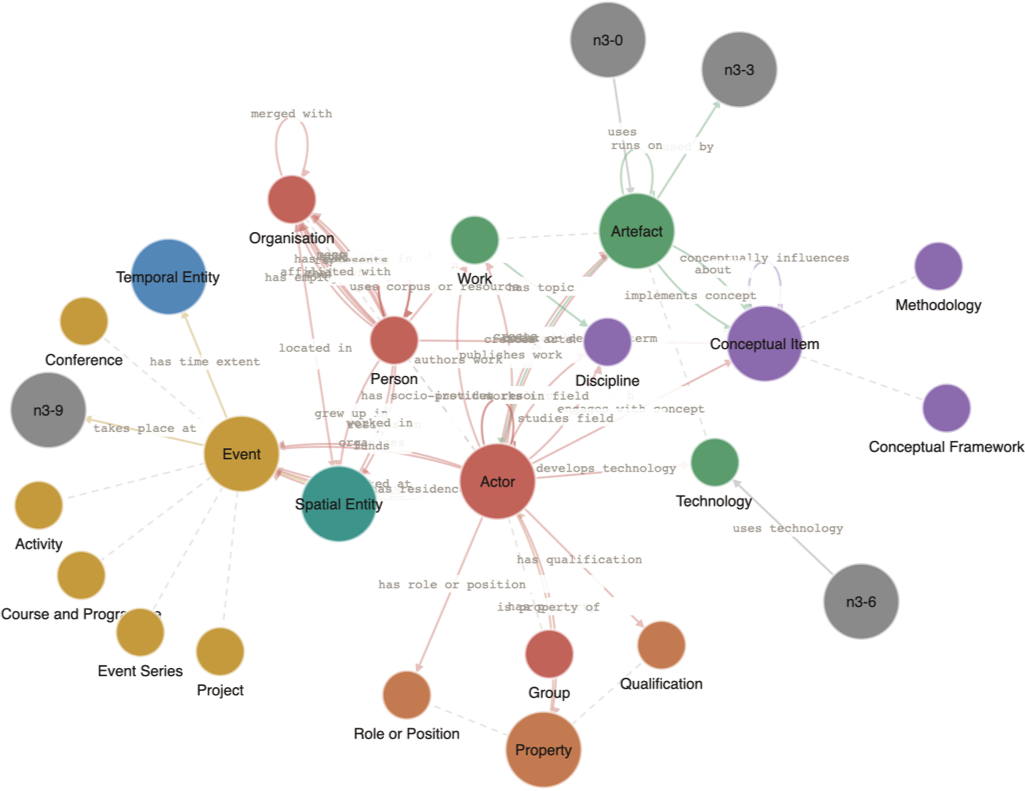
Built on a comprehensive knowledge graph, an OWL/RDF ontology, and a cross-lingual NLP pipeline, the project produces structured representations of oral history interviews that adhere to FAIR principles — discoverable, comparable, and re-interpretable across English and German sources.

"

Semantic infrastructure as a hermeneutic act: making structure, never flattening meaning.

Languages English · German
Stack OWL/RDF · NLP · FAIR
Active Since 2024
Explore MeDoraH